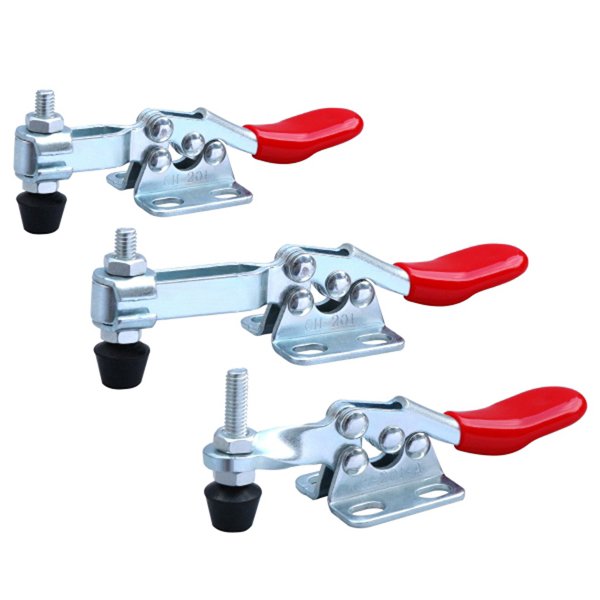
TL;DR:
A toggle is a lever mechanism that snaps between two stable positions. A latch is a fastener that holds two parts together. A toggle latch combines both, using over-center toggle action to apply clamping force. Use a toggle latch when you need adjustable, high holding force on vibrating equipment. Use a standard latch when speed of operation and low cost matter more.
1. Why These Two Terms Get Confused
The confusion exists because “toggle” and “latch” get used in two unrelated product categories: mechanical fasteners and electrical switches. Search either term and you’ll find mechanical engineers arguing about clamping hardware in the same thread as AV techs debating software buttons on a MIDI controller. Different worlds, same vocabulary.
Both words describe a mechanism that secures a state. How they secure it depends entirely on which engineering domain you’re in, and that’s where people trip up.
Here’s the split:
| Term | Mechanical Hardware Domain | Electrical & Software Domain |
|---|---|---|
| Toggle | A mechanical linkage using over-center geometry to amplify force and lock in place (e.g., toggle clamp). | A physical lever switch, OR a logic state that switches back and forth between two modes (0 and 1). |
| Latch | A broad category of mechanical fasteners that hold two objects together (e.g., doors, panels, boxes). | A switch or circuit behavior that maintains state (stays on or off) after the initial actuation is removed. |
| The Hybrid | Toggle Latch: a specific fastener using an over-center mechanism to pull two objects together with high holding force. | Latching Toggle Switch: a lever-actuated switch that physically stays in the position you flip it to. |
In the mechanical world, “latch” is the umbrella term for a fastening device. “Toggle” is a specific physical mechanism, the over-center linkage. Combine them into “toggle latch” and you’ve got a latch that operates using a toggle mechanism. Simple enough once you separate the categories.
2. How a Toggle Mechanism Actually Works
At the geometric heart of every toggle device, whether it’s a 5,000-lb capacity industrial Destaco clamp or a small catch on a Pelican case, sits the over-center principle.
A toggle mechanism is a linkage of three pivot pins arranged in a line. When the lever is actuated, the middle pin moves toward the line created by the two outer pins. As the middle pin approaches dead center, the mechanical advantage of the lever approaches infinity. A small input force at the handle gets multiplied into a large clamping force at the business end.
Once the middle pin crosses the dead-center line, typically by 5 to 10 degrees, and hits a physical internal stop, the mechanism is “over-center.” That’s where the snap-action feel comes from.
More importantly, it becomes self-locking. Once the linkage is over-center, any reverse force from the workpiece pushing back against the clamp forces the linkage tighter against its physical stop. It can’t be pushed open from the load side. It can only be released by pulling the lever back across the center line.
Commercial toggle clamps routinely achieve mechanical advantage ratios between 10:1 and 40:1. That’s how a technician applies 10 lbs at the lever and generates 400 lbs of clamping force on a welding fixture.
(Visual prompt: Annotated diagram of an over-center linkage showing the three pivot points, the dead-center line, and the 5–10 degree locking margin.)
3. How a Latch Actually Works (And the Main Types)
In mechanical engineering, a latch is a basic fastening device meant to join two surfaces while allowing for regular separation. Its core function relies on a keeper (or strike plate) mounted on one surface, and a catch mechanism on the adjoining surface.
Unlike a permanent fastener like a bolt or rivet, a latch is meant to be operated quickly, often without tools. Traditional latches don’t inherently multiply force the way a toggle does.
The five main categories of industrial latches:
- Cam Latch: Operates via a rotating cam that engages behind a frame. Simple quarter-turn locking motion, minimal mechanical advantage.
- Slam Latch (Push-to-Close): A spring-loaded pin or pawl that retracts when pushed against a strike plate and snaps into a hole. Automotive doors, server racks. Typical holding force: 50–150 lbs.
- Compression Latch: A variation on the cam latch that both rotates behind a frame and pulls inward, compressing a gasket for environmental sealing.
- Draw Latch: A simple hook or wire loop that reaches across a gap to catch a keeper, then pulls the two parts together. Note that many draw latches use toggle mechanisms, which blurs the category lines and is probably half the reason this article needs to exist.
- Rotary Latch: A rotating cam jaw that completely envelops a striker pin, preventing release in multiple axes. Heavy machinery, vehicle hoods. Typical holding force: 500–2,500 lbs.
(Visual prompt: A clean, 5-panel photo grid of a cam, slam, compression, draw, and rotary latch with labels.)
4. The Hybrid: What a Toggle Latch Really Is
A toggle latch is a mechanical fastener that uses over-center lever action to clamp two parts together with self-holding force.
This is where the over-center mechanism and the latching function fuse. A traditional spring-loaded draw latch relies strictly on the tension of a spring or flexible rubber strap to stay closed. A toggle latch uses rigid linkages, usually stainless steel or zinc-plated steel. You pull the handle down, the loop catches the keeper, and as the handle snaps past dead center, the mechanism locks rigidly into place.
Because it doesn’t rely on spring tension to stay closed, the toggle latch is the default choice in environments with heavy vibration, gasket compression, or high loads. Many industrial toggle latches come with threaded adjustable hooks, so the operator can fine-tune clamping force.
Mechanical Latch Comparison
| Feature | Toggle Latch | Standard Draw Latch | Compression Latch |
|---|---|---|---|
| Mechanism | Over-center linkage | Spring tension or flexible rubber | Threaded or cam pull-up |
| Typical Holding Force | 100 lbs – 3,800 lbs (450N – 17,000N) | 10 lbs – 150 lbs (45N – 650N) | 50 lbs – 200 lbs (220N – 900N) |
| Vibration Resistance | Exceptional (mechanically locked) | Poor to moderate (can stretch or unhook) | High (compresses against a gasket) |
| Adjustability | High (via threaded spindle) | None or minimal | Moderate (pre-set via lock nut) |
| Typical Cost | Moderate to high | Low | Moderate |
5. Toggle Switch vs. Latching Switch (The Electrical Side)
Plenty of people landing on this topic are dealing with electronics, so the terminology collision needs cleaning up.
In electrical hardware, “toggle” refers to a physical form factor. “Latching” refers to a behavioral logic state.
A toggle switch is a switch actuated by a physical lever (a bat or paddle). A latching switch is any switch that holds its position and circuit state after the operator removes their hand. The confusion comes from people assuming all toggle switches latch. They don’t.
- Latching Toggle Switch: Flip the lever up, the lights turn on, the lever stays up. Flip it down to kill the circuit. Common in home lighting and SPST/SPDT instrument panels.
- Momentary Toggle Switch: Push the lever up to run a winch. The moment you let go, an internal spring snaps the lever back to center and breaks the circuit. Common in heavy machinery controls.
A switch doesn’t need to be a toggle to latch. A push-button switch can be a latching switch (push once to turn on and lock, push again to release). So when an electrical engineer asks for a “latching switch,” they’re defining behavior, not form factor.
(Visual prompt: Side-by-side schematic symbols showing a momentary toggle switch with a spring return icon vs a maintained latching push-button.)
6. Side-by-Side Comparison: Toggle vs. Latch (Mechanical)
If you’re sourcing mechanical hardware and trying to decide between a standard clamping latch (cam or slam) and an over-center toggle, here’s the data-driven view.
| Specification | Toggle Mechanism / Toggle Latch | Standard Latch (Cam / Slam) |
|---|---|---|
| Primary Function | High-force clamping and immobilization | Simple panel securing and closure |
| Actuation Method | Over-center leverage | Direct physical push or 90-degree turn |
| Max Holding Force | Up to 5,000+ lbs (22 kN) | Usually capped around 150 lbs for basic models |
| Mechanical Advantage | Up to 40:1 ratio | 1:1 (direct action) |
| Cycle Life | Very high (20,000 to 100,000+ cycles) | Moderate (10,000 to 50,000 cycles) |
| Gasket Compression | Excellent (can crush heavy EPDM seals) | Poor to moderate |
| Vibration Resistance | Superior (stable equilibrium point) | Vulnerable to chatter and backing out |
| Best-Fit Applications | Welding jigs, Pelican cases, industrial enclosures, engine cowlings | Server racks, toolboxes, cabinet doors, access panels |
Data derived from commercial datasheets including Destaco, Southco, and Elesa component ratings.
7. How to Choose: A Decision Framework
Use a toggle latch when you need adjustable, high holding force on vibrating equipment. Use a standard latch when speed of operation, low profile, and cost matter more.
If you’re specifying hardware for a new product, run your requirements through this:
1. Is the load static or vibrating?
If it’s vibrating, you need an over-center toggle latch. I’ve watched this fail in person more than once. Field example: a maintenance team installed basic spring-loaded latches on a weatherproof 1/8-inch aluminum generator housing. The housing was running at around 2.8G of continuous 50Hz vibration (per the accelerometer data the team eventually pulled, after the failure). The springs fatigued, the latches entered harmonic resonance, and the keepers bounced clean off the strike plates. Rain on the electronics. Upgrading to stainless steel over-center toggle latches solved it because the toggle geometry locks mechanically, so it doesn’t care about 2.8G.
2. Do you need to compress a heavy environmental seal?
If you’re sealing an enclosure to IP67 and crushing a thick rubber gasket, a toggle latch is required to generate the mechanical advantage. A standard draw latch will leave the operator wrestling with the door.
3. Do you need adjustable clamping force?
Over time, gaskets take a “compression set,” meaning they flatten permanently. Toggle latches with threaded spindles let a tech tighten the latch by a few millimeters to restore tension. Standard latches have to be unbolted and remounted to adjust, which nobody actually does, which is why doors start leaking around year three.
4. How often will it be operated?
If a panel is opened fifty times a day, like a cabinet door, a push-to-close slam latch is drastically faster and more ergonomic than an over-center toggle. Nobody wants to flip a lever fifty times to grab a wrench.
5. What’s the spatial constraint?
Toggle mechanisms need room for the lever arm to sweep through a 90 to 180-degree arc. If space is at an absolute premium, a low-profile cam latch or a concealed slam latch is the right answer.
(Visual prompt: A yes/no flowchart mapping the 5 questions above to the final hardware recommendation.)
8. Common Failure Modes (and How to Avoid Them)
No hardware is immune to failure. Understanding how each mechanism dies in the field is half the job of designing a decent maintenance schedule.
Toggle Mechanism Failures
Because toggle latches are rigid and capable of generating significant force, their most common failure mode is yielding from over-tightening. If an operator cranks the threaded spindle too tight and then forces the lever over-center, you’ll exceed the tensile yield strength of the steel hook. The hook permanently stretches, or the mounting rivets rip straight out of the panel. I’ve spec’d replacement hardware for this exact failure on enclosures that were less than two years old, and frankly I still don’t have a good answer for how to idiot-proof it beyond training.
- The fix: Train operators that the mechanism only needs firm, moderate pressure to cross dead center. If two hands are required to close it, it’s adjusted too tight.
- Geometry drift: On thin sheet metal panels, the clamping force of a toggle can warp the panel over time. If the panel bows inward, the spatial distance between the latch and keeper shrinks and the latch effectively loosens.
Standard Latch Failures
Standard latches generally fail from vibration, misalignment, and spring fatigue.
- Keeper deformation: Slam latches rely on a pawl slamming into a strike plate. Over thousands of cycles, the strike plate gets deformed or gouged, and the door starts sitting loose.
- Corrosion: In non-toggle draw latches, the spring housing holds moisture beautifully, which is to say, badly. Once the internal spring rusts, the latch loses all tension.
- The fix: Specify stainless steel components for wet environments. Don’t use spring-tension latches on machinery with continuous harmonic vibration. Ever.
FAQs
Is a toggle the same as a latch?
No. A toggle is a mechanical linkage that uses over-center geometry to multiply force. A latch is a broad term for any fastener that holds two parts together. A “toggle latch” combines both: a fastener that locks using over-center force.
What is the holding force of a typical toggle latch?
Depending on size and material, industrial toggle latches generally provide between 100 lbs and 3,800 lbs of holding force. A standard 2-inch stainless steel toggle latch handles around 300 lbs. Heavy-duty industrial versions can exceed 17,000 Newtons (roughly 3,800 lbs). Manufacturers publish these numbers on their datasheets, and you should always check the specific part rather than trusting a range like the one I just gave you. The variation between brands is real.
Also worth noting: rated holding force is usually a static-load number. Vibration, gasket compression, and dynamic loads change the effective margin. Anecdotally I’d derate by at least 30% for any field application that sees real cyclic load, but check with your supplier on this one.
When should I use a toggle latch instead of a regular draw latch?
Upgrade to a toggle latch when the application involves heavy vibration, requires compressing a weather-tight gasket, or needs adjustable clamping force over time. Regular draw latches are fine for light-duty, static applications like wooden storage boxes.
Can a toggle switch also be called a latching switch?
Sort of. They describe different characteristics. “Toggle” describes the physical lever. If the lever stays put after you flip it, it’s a latching toggle switch. If it springs back to center, it’s a momentary toggle switch.
About the Author
The author is a mechanical specification specialist with extensive experience designing industrial hardware enclosures and specifying electromechanical components for heavy industrial environments, including MIL-STD vibration testing, NEMA enclosure ratings, and component life-cycle analysis.