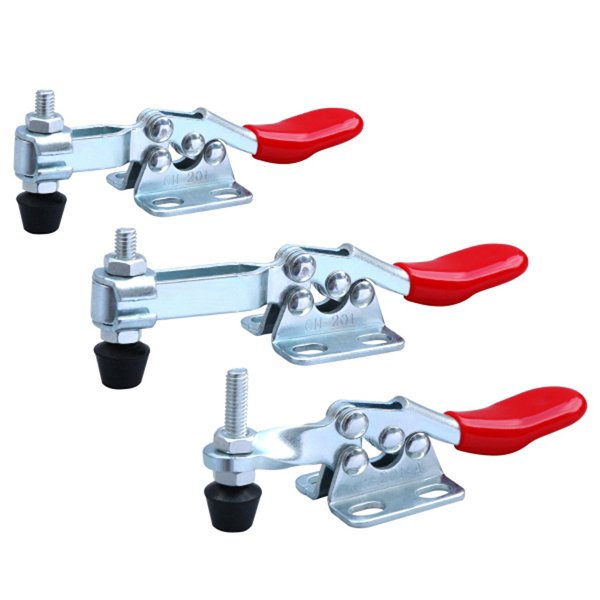
The five leading global toggle clamp brands are DE-STA-CO, Carr Lane, Kakuta, Good Hand, and JW Winco. They differ mainly in holding capacity accuracy, material grades, and how fast you can get a replacement when one dies on a Tuesday afternoon. Picking the right one is a budget-versus-cycle-life question, with industry certifications sitting on top of that. This guide walks through each on holding capacity, cycle life, material grade, global availability, certifications, price tier, and warranty.
How We Ranked the Five Brands (Methodology)
Seven criteria. Marketing claims don’t matter when you’re specifying tooling for a production run; what matters is whether the clamp behaves the way the datasheet says it will.
- Holding Capacity Accuracy — A 500-lb rated clamp shouldn’t yield at 450.
- Cycle Life — Clamps almost never fail from a single overload event. They fail at the pivot pins and rivets, from cyclic fatigue, usually long before anyone was expecting it.
- Material Grade — Standard clamps are zinc-plated carbon steel. Food and pharma need 304 or 316 stainless, no exceptions.
- Global Availability — A broken clamp on an assembly line needs a replacement today, not next week. Brands with real distributor networks score higher.
- Industry Certifications — Facilities should hold ISO 9001. Automotive and aerospace buyers look for IATF 16949 and AS9100.
- Price Tier — Benchmarked against a standard 500-lb horizontal hold-down.
- Warranty — Length and terms of the defect guarantee.
One thing worth flagging up front: machinist forum discussions consistently confirm what you see on the floor, which is that pivot pins and rivets are where these things give up. Nobody breaks a clamp body.
Brand #1 — DE-STA-CO Deep Dive
DE-STA-CO is a US-based manufacturer founded in 1915 as the Detroit Stamping Company. Now owned by Dover Corporation, they originally invented the manual toggle clamp, and that lineage still shows. “Destaco” is used generically to mean any toggle clamp, the way people say Kleenex for tissue. That’s branding worth about a billion dollars right there.
The catalog covers manual, pneumatic, and hydraulic. The flagship manual line is the 200 series. Model 225-U is the industry-standard horizontal hold-down: 500 lb (2224 N) capacity, U-bar arm. If you’ve worked in a US manufacturing plant in the last forty years, you’ve touched one. Manufacturing is global, with facilities in North America, Europe, and Asia, and availability through the usual suspects like McMaster-Carr and MSC.
Where it gets interesting is the premium-tier models. Hardened bushings on the upper-end SKUs genuinely extend cycle life in a way you can measure on a weld line, and the pneumatic drop-in replacements for manual clamps are the cleanest conversion path in the industry if you’re automating an existing fixture.
Pros
- Distributor network means next-day replacement in most regions.
- Pneumatic drop-ins for manual clamps are a huge deal for retrofit work.
- Hardened bushings on premium models actually earn their keep.
Cons
- Highest price tier in manual clamps.
- Standard-tier models don’t outlast mid-tier competitors by enough to justify the premium. I still spec them anyway on anything safety-critical, mostly out of habit and because nobody ever got fired for buying DE-STA-CO.
Brand #2 — Carr Lane Deep Dive
Carr Lane is US-based, founded 1952, headquartered in St. Louis. They specialize in modular fixturing, alignment pins, and aerospace workholding.
Carr Lane positions itself as the engineering-driven alternative to DE-STA-CO, and in aerospace tooling that’s basically true. Their toggle clamps integrate with the broader Carr Lane fixturing ecosystem, which matters a lot if you’re already running their bushings and locating pins — you stay in one part number universe. Standard horizontals and verticals are available, but the real strength is the specialized stuff: heavy-duty forged clamps, auto-adjusting models. Aerospace tooling designers lean on them for the ISO 9001 controls and the domestic manufacturing footprint for traceability.
Pros
- Domestic engineering support that actually picks up the phone.
- Integration with Carr Lane modular fixturing.
- Dimensional consistency batch-to-batch is excellent.
Cons
- Pricing is comparable to DE-STA-CO or slightly higher.
- Smaller global footprint. Harder to source outside North America on short notice.
Brand #3 — Kakuta Deep Dive
Kakuta (Kakuta Manufacturing Co., Ltd.) is Japanese, based in Osaka. They’re dominant in APAC, especially among Tier-1 automotive and electronics assembly.
Kakuta clamps feel like Japanese manufacturing feels — tight tolerances, good rivets, minimal side-to-side play in the arm after thousands of cycles. The product line mirrors standard industry sizes closely enough that they’re drop-in replacements for most Western equivalents. If you’re running a high-volume line in Thailand or Vietnam, Kakuta is often the default spec sheet entry.
Pros
- Cycle life and pivot tolerances are a real strength.
- Cost-effective in APAC.
- Strong presence in automotive OEM supply chains.
Cons
- Limited North American and European distribution.
- English-language technical documentation is thin compared to the US brands.
Brand #4 — Good Hand Deep Dive
Good Hand Enterprise Co., Ltd. is Taiwan-based and produces a staggering share of the world’s toggle clamps. They sell both direct and as an OEM for Western tooling companies that private-label the product and mark it up. If you’ve bought a “house brand” toggle clamp from a mid-tier tooling catalog, odds are decent it was made by Good Hand.
They compete on price and hold ISO 9001. Naming often mirrors industry standards — the GH-225-D is a direct dimensional and capacity match (500 lbs / 227 kg) to the DE-STA-CO 225-U. For low-to-medium cycle work, woodworking jigs, or shops where the fixturing budget got cut again, Good Hand gives you the best capacity-per-dollar in the market, full stop.
The zinc plating is where you see the cost difference. In a dry assembly environment it holds up fine for years. Put it near a coolant mist or in a humid plant and the finish starts complaining within months. Pivot pins also show accelerated wear in high-cycle, heavy-vibration applications, which is exactly where you shouldn’t be using an economy clamp in the first place.
Pros
- Often 40% to 60% cheaper than premium US brands.
- Dimensional drop-ins for industry-standard models.
- Widely available globally through budget tooling distributors.
Cons
- Zinc plating degrades faster in harsh environments.
- Pivot wear accelerates under cyclic vibration.
Brand #5 — JW Winco Deep Dive
JW Winco supplies standard machine parts and operates as the North American partner of the German firm Ganter Griff. Products are engineered to DIN standards.
They own the regulated-industry segment: food processing, pharma, chemical. The GN 820 series is their horizontal toggle clamp line, offered in 304 and 316L stainless with FDA-compliant handles for washdown environments. If you need a clamp that will survive caustic cleaning cycles five times a shift, this is the shortlist.
Pros
- Best stainless selection for corrosive environments.
- DIN-standard predictability.
- European materials and build quality.
Cons
- Metric-first design requires adaptation for US shops on imperial fixturing plates.
- Premium pricing, particularly on 316L.
Side-by-Side Comparison and Selection Guide by Use Case
The table compares each brand on its standard 500-lb horizontal hold-down.
| Brand | Origin | 500-lb Horizontal Model | Price Tier | Best For |
|---|---|---|---|---|
| DE-STA-CO | USA / Global | 225-U | Premium | Global standardization |
| Carr Lane | USA | (exact SKU TBD) | Premium | Aerospace fixturing |
| Kakuta | Japan | (exact SKU TBD) | Mid-Tier | APAC Automotive |
| Good Hand | Taiwan | GH-225-D | Economy | Woodworking / Low-cycle |
| JW Winco | Germany / Global | GN 820 | Premium | Food & Pharma (Stainless) |
Selection Guidance
- Automotive Fixtures: DE-STA-CO or Kakuta. Weld-line cycle counts demand hardened bushings and tight tolerances.
- Aerospace Tooling: Carr Lane. Domestic manufacturing and traceability meet AS9100 without a fight.
- Food Processing: JW Winco, 316L.
- Woodworking & Hobbyist: Good Hand. Static loads in woodworking rarely approach the fatigue limits of economy clamps, so a premium clamp here is just money you’re setting on fire.
FAQ
Which toggle clamp brand is best for heavy-duty industrial use?
DE-STA-CO and Carr Lane. Both offer forged steel models with hardened pivot pins built for high-vibration environments like robotic welding cells.
Are Good Hand or Kakuta clamps interchangeable with DE-STA-CO models?
Yes, in most cases. Good Hand and Kakuta deliberately match the hole patterns, reach, and holding capacities of standard DE-STA-CO models like the 200 series, which means direct drop-in replacement in the vast majority of fixtures. The one caveat: double-check the handle sweep clearance before you commit, because handle geometry sometimes varies by a few degrees between brands and that can bite you on a tight fixture layout. For the core mounting dimensions, though, interchangeability is the whole business model for these two suppliers.
What’s the typical lifespan of a quality toggle clamp in cycles?
A premium clamp used within its rated capacity can clear 100,000 cycles. Side-load it or push past the rating and the rivets stretch early. Side-loading is the usual killer, not overloading.
Which toggle clamp brands offer stainless steel for food-grade applications?
JW Winco and DE-STA-CO. JW Winco goes deeper on 316L with FDA-compliant handles.
How much do premium toggle clamps cost versus budget alternatives?
Ballpark, from what I’ve seen over the last couple of years: a standard 500-lb budget clamp like a Good Hand runs around $10 to $15. The DE-STA-CO or Carr Lane equivalent is usually in the $30 to $45 range depending on the distributor. Current pricing shifts with distributor markups, so pull a live quote before you build a BOM around any of these numbers.